
Choosing the right cooling system for a factory, warehouse, commercial building, or large workspace is not just about lowering temperature—it’s about air distribution, energy efficiency, comfort, and long-term performance. Two commonly used solutions in large-area cooling are duct coolers and industrial coolers.
While both are designed to cool big spaces, their working principles, performance, and suitability vary significantly. This guide breaks down the real differences in a simple, practical way—so you can make an informed decision based on your project needs.
Understanding Duct Coolers
A duct cooler is a cooling unit connected to a ducting network that distributes cooled air to multiple zones or areas. Instead of blowing air from a single point, duct coolers use factory-fabricated or site-installed ducts to deliver air evenly across the workspace.
Key Characteristics of Duct Coolers
- Centralized cooling system
- Connected to GI, MS, or pre-insulated ducts
- Controlled and directional airflow
- Suitable for zoned cooling
- Works well with diffusers, grilles, and dampers
Duct coolers are commonly used where uniform airflow and controlled temperature distribution are essential.
Understanding Industrial Coolers
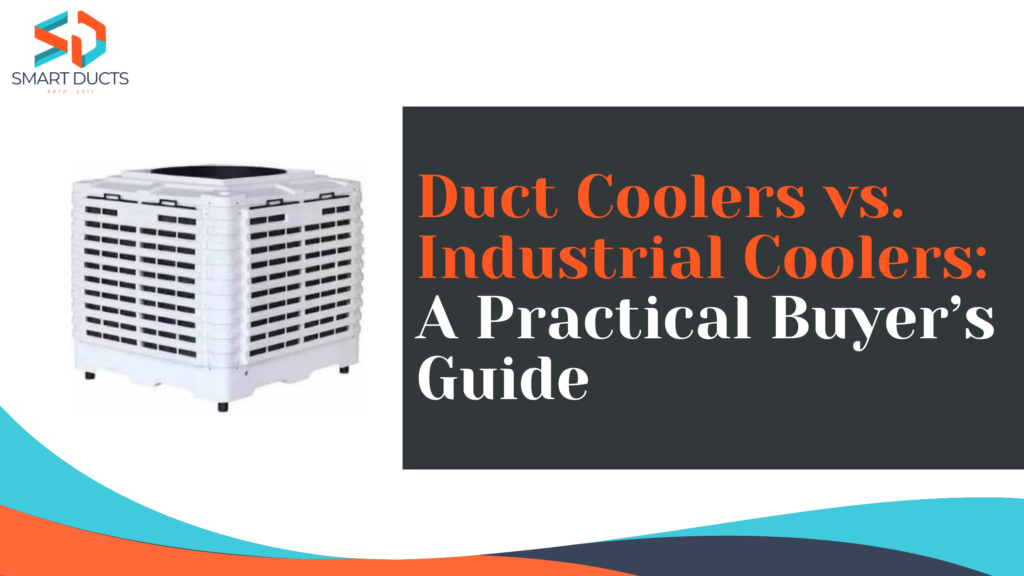
An industrial cooler (often referred to as an evaporative air cooler) is a standalone unit designed to cool large areas by blowing air directly into the space. These coolers are usually placed on the floor, roof, or wall and supply air from one or more outlets.
Key Characteristics of Industrial Coolers
- Single-point or limited-point air discharge
- High air volume output
- Faster installation
- Lower initial cost
- Best for open or semi-open spaces
Industrial coolers are widely used in factories, workshops, and warehouses where spot cooling is sufficient.
Air Distribution: The Biggest Difference
One of the most important differences between duct coolers and industrial coolers is how air is distributed.
- Duct Coolers distribute air evenly through ducts and diffusers, ensuring consistent temperature across large areas.
- Industrial Coolers deliver air directly, which often leads to uneven cooling—areas closer to the cooler feel colder, while distant areas remain warm.
If your facility requires balanced airflow without hot spots, duct cooling offers a clear advantage.
Space Size & Layout Considerations
Duct Coolers Are Ideal When:
- The space has multiple rooms or zones
- Uniform cooling is required across the entire floor
- Ceiling ducting is possible
- Interior comfort and aesthetics matter
Industrial Coolers Are Better When:
- The area is open and unobstructed
- Cooling is needed only in specific zones
- Installation time needs to be minimal
- Budget constraints are high
Energy Efficiency & Operating Costs
At first glance, industrial coolers may seem more economical due to their lower purchase price. However, long-term energy performance tells a different story.
- Duct coolers, when properly designed, can reduce energy wastage by directing air only where required.
- Industrial coolers may consume more power in large spaces due to air loss and repeated operation to maintain comfort.
For facilities operating long hours, duct cooling systems often prove more cost-efficient over time.
Noise Levels & Workplace Comfort
Noise is a major concern in offices, commercial buildings, and production areas.
- Duct coolers are quieter because the cooling unit is placed away from occupied zones, and air reaches the space through ducts.
- Industrial coolers generate higher noise since the unit operates directly within the working area.
If employee comfort and productivity are priorities, duct coolers offer a noticeable advantage.
Installation & Maintenance
Duct Coolers
- Require professional duct design and installation
- Higher initial setup effort
- Easier airflow control using dampers
- Cleaner and more organized layout
Industrial Coolers
- Quick installation
- Minimal ducting
- Easier relocation
- Regular cleaning needed due to dust exposure
Which One Should You Choose?
Here’s a simple way to decide:
| Requirement | Better Choice |
|---|---|
| Even cooling across large area | Duct Cooler |
| Zoned or controlled airflow | Duct Cooler |
| Open factory or warehouse | Industrial Cooler |
| Lower upfront cost | Industrial Cooler |
| Quiet operation | Duct Cooler |
| Long-term efficiency | Duct Cooler |
Why Duct Coolers Work Best with Smart Ducts Solutions
At Smart Ducts, we specialize in high-quality ducting systems that enhance the performance of duct coolers. Our factory-fabricated ducts, MS ducting, volume control dampers, and diffusers ensure:
- Optimized airflow
- Minimal leakage
- Improved cooling efficiency
- Longer system life
A duct cooler performs only as well as the ducting system connected to it—and that’s where Smart Ducts adds real value.
Final Thoughts
There is no one-size-fits-all answer when choosing between duct coolers and industrial coolers. The right decision depends on space layout, cooling expectations, budget, and long-term operating goals.
If you’re planning a professional HVAC setup with controlled airflow, better comfort, and energy efficiency, duct coolers combined with high-quality ducting are often the smarter investment.
Looking for the right ducting solution to support your cooling system?
Visit Smart Ducts to explore factory-fabricated ducts, MS ducting, dampers, and air distribution products designed for efficient cooling and long-term performance.
📞 Contact Smart Ducts today to discuss your HVAC project requirements with industry experts.